Heather Kim

Upson 529
Cornell University
Ithaca, NY
My research is motivated by textile-based wearables that integrate actuation and sensing. In the grand scheme, I envision that fiber-form sensors, actuators, and user-friendly fabrication tools will empower healthcare providers and transform these wearables into equitable healthcare solutions. I am interested in developing responsive fibers and deformable structures, as well as overcoming hardware limitations when devices are integrated into fabric structures.
I am currently a postdoctoral associate in the Sibley School of Mechanical and Aerospace Engineering at Cornell University. I completed my PhD in Human Behavior and Design at Cornell in May 2024. My work has been published at robotics and HCI venues, such as IEEE IROS, CHI, IMWUT, and DIS, with Best Paper Honorable Mention awards. My work has also been featured in the Daily Mail, New Atlas, Trend Hunter, Hackster.io, and the Cornell Chronicle, culminating in my selection as an EECS Rising Star 2023.
Research
In my research, I work across a broad class of polymer-based materials, extending well beyond textiles. The applications of my core research framework can be distilled into three thrusts.
Compliant Health Devices That Modulate User Physiology
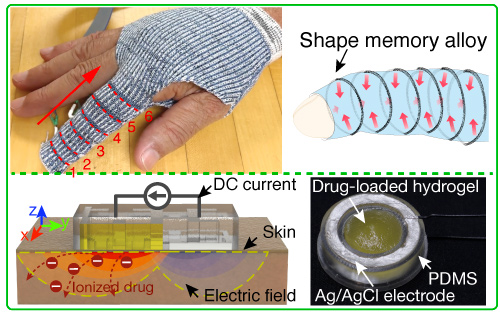
I focus on devices that modulate user health via integrated mechatronic systems (sensing, actuation, control) and targeted biochemical interventions (e.g., transdermal drug delivery). Mechatronic devices apply controlled mechanical forces to the body using responsive materials or soft actuators that interface directly with skin; these devices can help mobilize lymphatic fluid in patients with lymphedema. Biochemical devices deliver therapeutic agents across the skin, often in a spatially and temporally controlled manner; such approaches can be used to alleviate metabolic dysfunction. Designing and controlling these systems requires deep understanding of material properties and the underlying physics; I aim to enable programmable, tunable material behavior in these devices.
Compliant Transducers: Sensors and Energy Generators
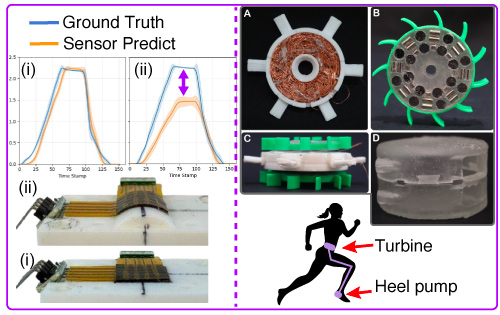
To personalize health devices, I develop compliant sensors that can extract mechanical and biochemical information from the user. Flexible mechanical sensors have traditionally been designed for relatively rigid, planar interfaces. But the human body presents complex, curved, and deformable surfaces with very different mechanical and geometric properties. Biochemical sensors convey metabolic information, enabling more accurate inference of the user’s physiological state. I develop fiber-based sensors and integrate them into wearable systems. In a different vein, for healthcare devices to function over extended durations, they must be self-sustaining. To this end, I am exploring how subsystems that harvest energy from user motion can be incorporated into such devices (work in progress).
Compliant Actuating Wearables That Perform On-Body Tasks
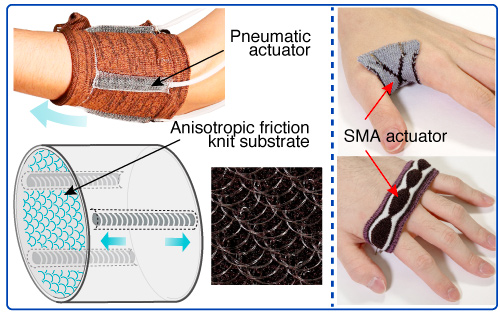
Soft wearable devices are particularly effective at performing specific tasks on the user's body. I have developed wearable devices that enable locomotion on the body and deliver tactile feedback. Although these systems do not directly modulate the user's biological state, they can supplement health devices or carry out assistive functions.
News
| Oct 07, 2026 | My paper on transdermal drug delivery has been accepted for publication in IEEE Transactions on Biomedical Engineering (TBME)! Preprint coming soon. |
|---|---|
| Jul 12, 2026 | A bit late, but I attended 2026 BIO International Convention in San Diego, as part of the NSF I-Corps Regional Program. |
| Apr 03, 2026 | Our paper was accepted to the 17th World Symposium on the Algorithmic Foundations of Robotics (WAFR)! This project started during my PhD and has been near and dear to my heart - a swarm of robots that can infer their surroundings using minimalistic computation. Huge credit to Alex Nilles for leading the work, with support from Kirstin. The work will appear in Springer Advanced Robotics. Check back in for more details. |
| Dec 20, 2025 | Two papers accepted to the Haptics Symposium and TEI! Fun collaborations with Luoyan Zhong and Dr. Jo’s group at U of Georgia. We have open sourced our Haptics Symposium paper here. Looking forward to seeing everyone in Chicago and Reno  . . |
| Sep 25, 2025 | I’m incredibly honored and grateful to my lab for their support in helping me receive the Postdoctoral Achievement Award. |
Latest posts
| Aug 10, 2024 | Intro to Digital Knitting |
|---|


